
The Veil Report

LIVE • Weekdays 10PM CT • The Veil Report with J.C. Wilder 

LAS VEGAS •

Share:

1970’s Declassified Documents Point to Secret Underground Networks

A national complex of deep tunnels, shared by passenger craft, freight, power lines, pipelines, and communications waveguides, bored through solid rock by machines that melt the earth instead of hauling it out.


Editor’s note: Reporting drawn from Rand.org. Archive.org, Google Patents, OSTI.gov.
Secret Underground Networks
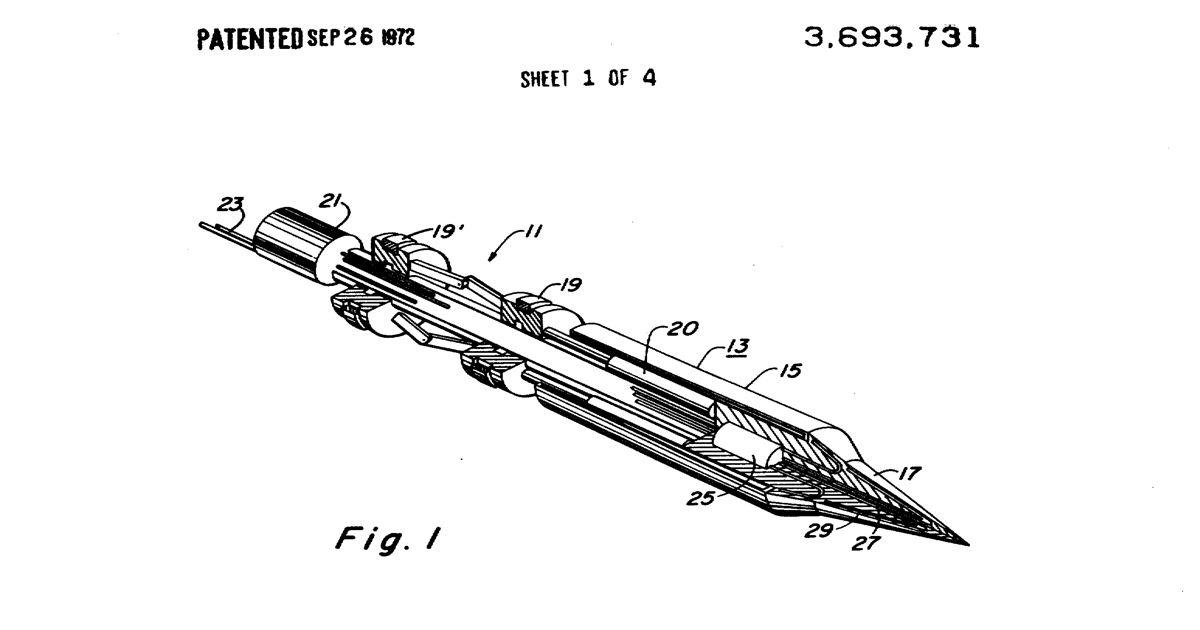
U.S. Patent 3,693,731 Method and Apparatus for Tunneling by Melting

In the early 1970s, while the public was being sold the interstate and the jet age, two government-adjacent shops were writing in plain English about something else: a national complex of deep tunnels, shared by passenger craft, freight, power lines, pipelines, and communications waveguides, bored through solid rock by machines that melt the earth instead of hauling it out.

The papers are catalogued. RAND still hosts them. The old Atomic Energy Commission reports still sit on government document servers. The patents were assigned to the United States. None of them is a map of a finished secret railroad. They are feasibility studies, staff papers, and patents. Read carefully, they are more interesting than a map. They are the engineering case for an underground network that would leave almost no surface trace, and they name the machine that would cut it.

The man at RAND

Robert M. Salter, a RAND physicist, put his name on staff paper P-4874 in August 1972: The Very High Speed Transit System. RAND’s disclaimer is still on page one. The views are the author’s, not official policy. That does not make the paper unofficial. It means a senior researcher at the country’s premier military-and-policy think tank wrote it, and RAND reproduced it.

Electromagnetically levitated “tubecraft” ride inside evacuated tunnels. His nonstop coast-to-coast case, constant one-g acceleration and deceleration, is 21 minutes. Two intermediate stops push it to 37. Speeds examined in the RAND work run as high as 14,000 mph. The car surfs an electromagnetic wave in the tunnel wall. A superconducting loop on the vehicle carries on the order of a million amperes. Accelerate, and it takes energy from the field. Decelerate, and most of that energy goes back.

The part that matters is not the speed. Salter is not describing a subway. He is describing a tunnel complex. The same bores carry oil, water, and gas pipelines, laser and microwave waveguides, electric power lines including superconducting lines, and freight. The passenger system is one tenant. The network is the product.

RAND P-4874 · full scan

Planetran, and the machine that melts rock

In January 1978 he came back with P-6092, Trans-Planetary Subway Systems: A Burgeoning Capability. The system has a name: Planetran. Evacuated-tube cars, electromagnetically supported, built to cross the United States in an hour, tied into local transit, with the same shared complex for utilities and freight.

Then he says where the tunnels go. Several hundred feet underground, in solid rock. Tunneling is most of the cost. The borers he names are not city-subway machines. Hypersonic projectile spallation. Laser devices. And the Subterrene, a heated tungsten probe that melts through igneous rock.That last name is a Los Alamos program.

RAND P-6092 · full scan

Los Alamos and the Nuclear Subterrene

On January 1, 1971, six Los Alamos authors — E. S. Robinson, R. M. Potter, B. B. McInteer, J. C. Rowley, D. E. Armstrong, and R. L. Mills — issued LA-4547, Preliminary Study of the Nuclear Subterrene. The heat source is a compact nuclear reactor. Heat pipes move that heat to the face. The rock does not come out as muck. It melts, flows aside, and freezes as a glass lining. The excavation and the structure are the same act.

U.S. Patent 3,693,731, Method and apparatus for tunneling by melting, was filed January 8, 1971, and granted September 26, 1972, to the Atomic Energy Commission. Same inventors. The abstract says the heat source “can be electrical or nuclear but for deep drilling is preferably a nuclear reactor.” Molten rock can be pushed into cracks or formed into a vitreous lining. The patent cites Los Alamos report LA-3243 (1965), Rock Melting as a Drilling Technique, and notes that conventional methods are unlikely to work past about 12 to 15 kilometers.

Two more patents, filed in 1974 and granted in May 1975, went to the Energy Research and Development Administration. Patent 3,881,777 covers large tunnels in soft ground. Patent 3,885,832 covers hard rock: melt a boundary kerf, form a liner from the melt, shatter the core by thermal stress. Heat, again, from a compact nuclear reactor.

LA-4547 at UNT · OSTI · Patent 3,693,731 · 3,881,777 · 3,885,832

What they actually built

Electrically heated prototypes were built and tested. Status report LA-5459-SR, covering late 1972 through September 1973, describes the program under partial support from the National Science Foundation. A later report, September 1973 through June 1976, says small-diameter electric melting penetrators were developed and field-tested, and the glass linings were studied in a variety of rocks and soils. Geothermal well-holes were a stated use.

There is no public record that an operational nuclear Subterrene was ever fielded. The reactor version is a studied and patented design. The electric version is hardware that melted rock and left a glass tube.

LA-5459-SR PDF · 1973–1976 status report · role in future excavation, 1974 · large-tunnel preliminary study, 1973

Why the two files belong together

By 1978 Salter is naming the Subterrene as one of three advanced borers his national tunnel system would need. The Los Alamos patents are assigned to the civilian nuclear agencies of the United States, and their main operational feature is the absence of spoil. No conveyor. No tailings pile at the portal. The rock that was in the way becomes the wall.

The paper trail says a national underground tube network was designed, passenger craft as only one use. Tunnels were specified for solid rock, several hundred feet down. The borer named in the RAND brief melts igneous rock and, in the Los Alamos design, lines the bore with glass as it advances. The preferred heat source for deep work, on the face of a U.S. patent, is a compact nuclear reactor. Electric prototypes of that penetrator were built and tested at Los Alamos through the mid-1970s.

It does not say Planetran was built, or that a nuclear Subterrene cut a coast-to-coast line. RAND still calls both Salter papers concepts. Los Alamos’s own status reports describe a research program, not a fleet.

The open question is the one the documents force. If the United States spent the first half of the 1970s patenting a spoil-free nuclear borer and briefing a deep multi-use tunnel network that would use it, the absence of a public construction program is not the end of the inquiry. Programs with this profile do not advertise their portals.

The Veil Report reads the paper, then asks who paid for the machine that does not leave a pile. Ask any man you know: If he sets his mind on a trans planetary tunneling project... Does he finish the job?.

The Truth Lives Behind the Veil - J.C. Wilder - theveilreport.com

Share: